
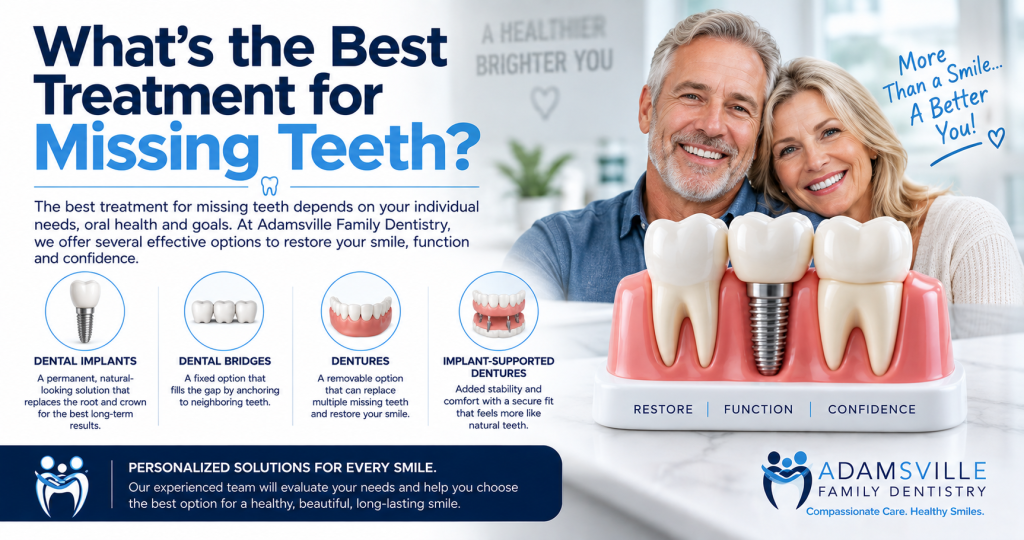
What is the best treatment for missing teeth? For most patients, a dental implant comes closest to giving back what was lost, because it replaces the root as well as the visible tooth. But the best treatment is the one that fits your mouth, your health, and your budget, and that looks different for someone missing one back molar than it does for someone who has worn a loose upper denture for ten years.
At Adamsville Family Dentistry we replace missing teeth with implants, bridges, partials, and full dentures. Below we compare the main options side by side, explain what happens if you leave a gap alone, and walk through how to decide which treatment makes the most sense for you.
Missing Teeth Questions Answered
What is the best treatment for missing teeth?
What happens if I do not replace a missing tooth?
How much does it cost to replace a missing tooth?
Am I too old for dental implants?
How long does it take to replace a missing tooth?
Can I replace several missing teeth at once?
Why Replacing a Missing Tooth Matters
A gap in the back of the mouth is easy to ignore because no one sees it. The trouble is that your teeth work as a set. Remove one and the balance changes: you start chewing on the other side, the tooth above or below the space grows into it, and the teeth beside it lean in. Within a few years, a bite that used to feel effortless can start causing sore jaw muscles, worn enamel, and teeth that are much harder to floss.
The jawbone is the quieter issue. Bone maintains itself in response to pressure from a tooth root. Take the root away and the ridge begins to resorb, most rapidly in the first twelve months. That is why a denture that fit well five years ago rocks today, and why replacing a tooth sooner usually means fewer procedures later.
Comparing Your Options for Missing Teeth
| Treatment | Best For | Typical Lifespan | Protects the Bone? |
|---|---|---|---|
| Dental implant | One or several missing teeth with healthy bone | 20 years to a lifetime | Yes. Replaces the root |
| Dental bridge | One or two teeth in a row with solid teeth on both sides | 10 to 15 years | No. Bone under the gap still shrinks |
| Partial denture | Several missing teeth in the same arch | 5 to 10 years | No |
| Full denture | An entire upper or lower arch | 5 to 10 years, with relines sooner | No |
| Implant-supported denture | A full arch that needs a secure, non-slip fit | 20 years or more for the implants | Yes, where the implants sit |
Notice the pattern in the last column. Implants are the only options that address what is happening beneath the gum, which is why they tend to be the most stable choice over decades. Bridges and dentures restore appearance and chewing very well, and for many patients they are exactly the right call, but they rest on a ridge that continues to change shape.
Signs You Should Not Wait to Replace a Missing Tooth
Some gaps can be planned around for a while. Others are actively causing damage. Call us sooner rather than later if you notice any of these:
- Food packs into the space every time you eat
- You chew on one side only out of habit or discomfort
- A neighboring tooth has tilted or feels loose
- Your bite feels off or your jaw muscles ache in the morning
- Speech has changed, with whistling or slurring on certain sounds
- A denture or partial rocks or rubs where it used to sit firmly
Each of these means the surrounding teeth and bone are already adapting to the gap, and the longer that continues, the more involved the fix becomes.
Treatment Options for Missing Teeth
After an exam and imaging, we will lay out the options that will actually work in your mouth and explain the trade-offs of each. These are the four we recommend most often.
Dental Implants
Partial Dentures
Full and Implant-Supported Dentures
How to Choose the Right Option for You
Four things usually decide it. First, how much healthy bone is left, which determines whether an implant can be placed as is or needs a graft first. Second, the condition of the teeth on either side of the gap: if they are already crowned or heavily filled, a bridge puts them to good use, but if they are pristine, an implant avoids reshaping healthy enamel. Third, how many teeth are missing and where, since scattered gaps often point toward a partial while a single gap points toward an implant or bridge.
Fourth is the practical side. Some patients want the fastest path back to normal chewing, some want the lowest cost this year, and some want the option they will never have to think about again. Those are all legitimate priorities, and we would rather build the plan around yours than push everyone toward the same treatment.
Missing Tooth Treatment at Adamsville Family Dentistry
Every replacement plan here starts with a clear picture of what we are working with. We use 3D cone beam imaging to measure bone height and width and to map the nerve before any implant is placed, and iTero digital scanning to take impressions without a tray of putty.
If a failing tooth still has to come out first, we handle extractions and oral surgery in the same office, so your care stays in one place. Our SOLEA laser lets us do many procedures with little or no anesthetic, and sedation options are available if dental visits make you anxious. Browse our full range of restorative services to see what else is available.
Not Sure Which Option Is Right for You?
Come in for an exam and we will show you your own images, explain what each option would involve, and give you the cost before you decide anything.
Adamsville Family Dentistry
518 East Main St. · Adamsville, TN 38310 · (731) 632-3371
Replace What Is Missing and Eat, Speak, and Smile Normally Again
Whether it is one tooth or a full arch, there is a solution that will fit your mouth and your budget. Our team will help you find it.