
Can a Cracked Tooth Be Saved?
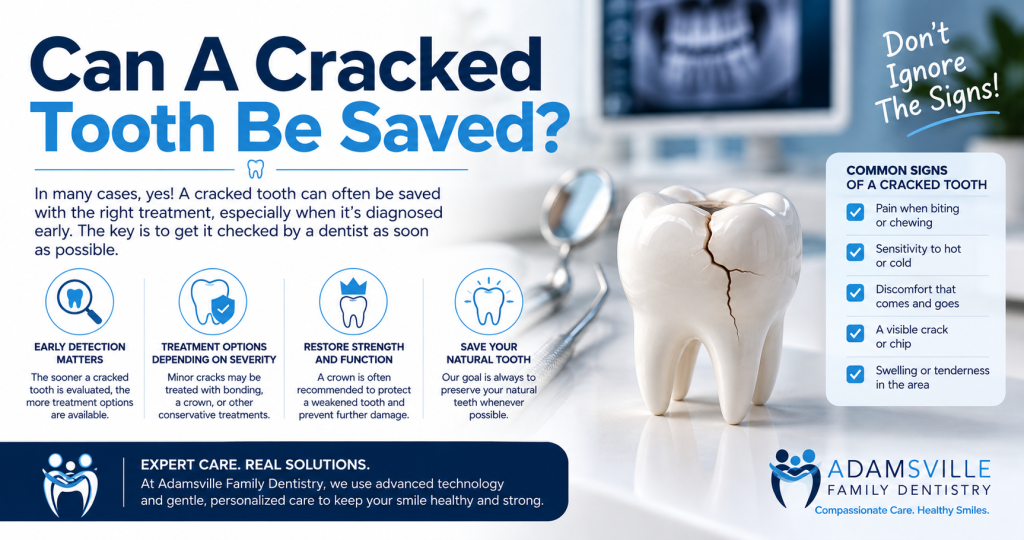
Can a cracked tooth be saved? In most cases, yes. It is one of the most common questions we hear at Adamsville Family Dentistry, usually from someone who bit down on something hard, felt a sharp twinge, and is now worried they are about to lose a tooth. The reassuring truth is that modern dentistry can save the majority of cracked teeth, but the outcome depends heavily on two things: how deep the crack goes, and how quickly you get it looked at.
\nA crack that stays in the outer enamel or upper part of the tooth is very treatable. A crack that runs below the gum line or splits the root is a different story. Because you cannot tell the difference by looking in the mirror, the single most important step is a prompt exam. Below are the questions patients ask us most, followed by a closer look at the types of cracks, the warning signs, and the treatments that can keep your natural tooth where it belongs.
Cracked Tooth Questions Answered
How do I know if my tooth is cracked?
Will a cracked tooth heal on its own?
Is a cracked tooth a dental emergency?
Does a cracked tooth always need a root canal?
Can a cracked tooth be saved if it broke below the gum line?
How much does it cost to fix a cracked tooth?
What Causes a Tooth to Crack?
Teeth are remarkably strong, but they are not indestructible. The most common culprits we see in Adamsville are biting down on hard foods like ice, hard candy, popcorn kernels, or unpopped kernels hidden in the bowl. Nighttime grinding and clenching, known as bruxism, is another major cause because it applies hundreds of pounds of pressure to the same teeth night after night.
\nLarge, older fillings can also weaken a tooth from the inside, leaving thin walls of enamel that eventually give way. Sudden temperature swings, such as drinking ice water right after hot coffee, cause the enamel to expand and contract and can create hairline fractures over time. Finally, a blow to the face from a fall, a sports injury, or an accident can crack a tooth instantly. Age plays a role too: most cracked teeth we treat are in patients over 50, simply because those teeth have absorbed decades of chewing.
Types of Cracked Teeth and Whether They Can Be Saved
| Type of Crack | What It Means | Can It Be Saved? |
|---|---|---|
| Craze lines | Tiny surface cracks in the enamel only | Yes. Usually cosmetic and needs no treatment |
| Fractured cusp | A piece of the chewing surface breaks off, often near a filling | Yes. Typically repaired with a crown or onlay |
| Cracked tooth | A crack runs from the chewing surface toward the root | Usually. Crown, sometimes with a root canal, if caught early |
| Split tooth | The crack has separated the tooth into distinct pieces | Rarely. Part of the tooth may be saved; often extraction |
| Vertical root fracture | A crack that starts in the root and travels upward | Rarely. Extraction and replacement is usually recommended |
The pattern is clear: the higher on the tooth the crack stays, the better the prognosis. That is why we tell patients not to wait. A fractured cusp treated this month is a straightforward crown. The same tooth ignored for a year may become a split tooth that cannot be saved.
Signs You May Have a Cracked Tooth
Cracked tooth syndrome is notoriously tricky because the pain is often inconsistent. You may feel a sharp jolt when biting a specific way and then nothing for days. Watch for these signs:
\n- \n
- Pain when chewing, especially when you release the bite \n
- Sensitivity to temperature that lingers or seems tied to one tooth \n
- Discomfort with sweets without a visible cavity \n
- Intermittent pain that is hard to pin to one spot \n
- Gum swelling or a small bump near a single tooth \n
- A rough or sharp edge you can feel with your tongue \n
Because these symptoms overlap with cavities, gum disease, and sinus pressure, self-diagnosis is unreliable. If something feels off with one tooth, let us take a look.
Treatment Options That Save Cracked Teeth
Once we have located the crack and confirmed how far it extends, we will recommend the least invasive treatment that will reliably protect the tooth. Here are the four options we use most often.
Dental Bonding
Dental Crown
Root Canal and Crown
Extraction and Replacement
What to Do Right Now if You Think Your Tooth Is Cracked
If you suspect a crack, a few simple steps can protect the tooth until we see you. Rinse gently with warm water to clear away debris. Chew on the opposite side of your mouth and avoid very hot, cold, or hard foods. If a piece of the tooth broke off, save it in a small container with a little milk or saliva and bring it to your appointment. Over-the-counter pain relievers can ease discomfort, and a cold compress on the cheek helps with swelling.
\nWhat you should not do is wait to see whether it gets better. Cracks only move in one direction, and a few days of putting it off can be the difference between a crown and an extraction.
Cracked Tooth Care at Adamsville Family Dentistry
At Adamsville Family Dentistry, diagnosing cracked teeth is something we do every week. We use 3D cone beam imaging and an intra-oral camera to find fractures that traditional X-rays miss, so you get an accurate answer about whether your tooth can be saved and exactly what it will take.
\nTreatment is designed around your comfort. Our SOLEA laser allows many procedures to be done with little or no anesthetic, and sedation options are available if dental visits make you anxious. If you grind your teeth, we will also talk about a custom night guard so the same thing does not happen to the tooth next door.
Think Your Tooth Might Be Cracked?
The sooner we see it, the more of your natural tooth we can save. Call today and we will get you in quickly for an exam and a clear plan.
Adamsville Family Dentistry
518 East Main St. · Adamsville, TN 38310 · (731) 632-3371
Save Your Tooth Before the Crack Spreads
Most cracked teeth can be saved when they are treated early. Our team is ready to examine your tooth, explain your options, and restore your smile.