
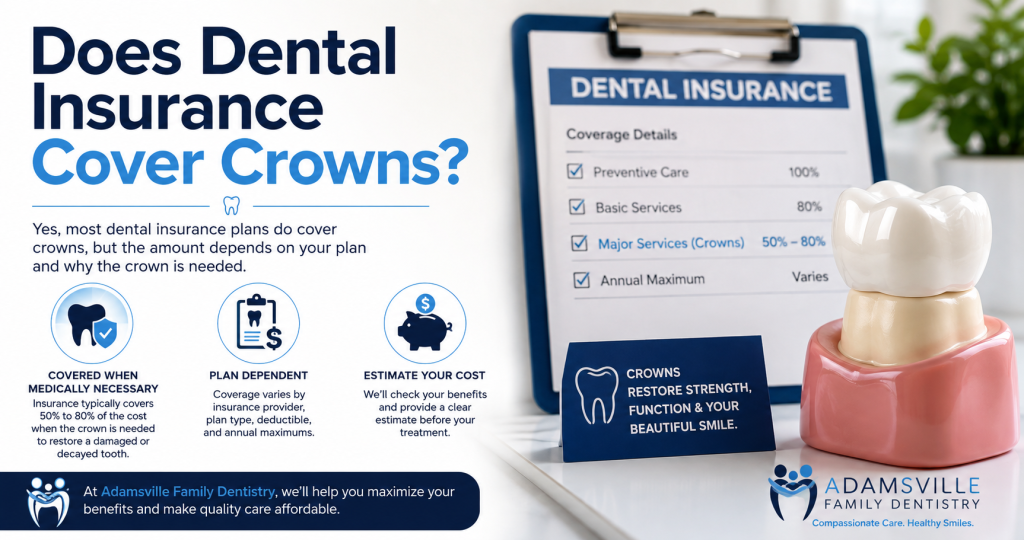
Does dental insurance cover crowns? For most patients, the answer is yes — the majority of dental insurance plans do help pay for crowns, typically covering somewhere between 50% and 80% of the cost when the crown is needed to restore a damaged or decayed tooth. The exact amount you’ll pay out of pocket depends on your specific plan, your deductible, your annual maximum, and — importantly — why the crown is being recommended in the first place.
At Adamsville Family Dentistry, we know that insurance questions can feel just as stressful as the dental work itself. That’s why our team checks your benefits, explains your coverage in plain language, and provides a clear cost estimate before treatment ever begins. Below, we’ve answered the most common questions patients ask about insurance and dental crowns — followed by a deeper look at how coverage works and how to get the most from your benefits.
Dental Insurance & Crowns: Your Questions Answered
Does dental insurance cover crowns?
Yes, most dental insurance plans cover crowns when they are medically necessary — meaning the crown is needed to restore a tooth that is cracked, broken, severely decayed, worn down, or weakened by a root canal or large filling. Crowns are usually classified as a “major service,” which most plans cover at 50% to 80% after your deductible. Purely cosmetic crowns, placed only to improve appearance, are typically not covered.
How much does insurance typically pay for a crown?
Most plans pay 50% of the cost of a crown, though some richer plans pay up to 80% for major services. If a crown costs $1,200 and your plan covers 50%, insurance would pay around $600 — assuming you’ve met your deductible and haven’t used up your annual maximum. Because every plan is different, the most reliable way to know your number is to request a pre-treatment estimate, which our team is happy to submit for you.
Why do insurance plans classify crowns as a "major service"?
Dental plans generally sort care into three tiers: preventive care (cleanings, exams, X-rays) covered at or near 100%, basic services (fillings, simple extractions) covered around 70% to 80%, and major services (crowns, bridges, dentures, implants) covered around 50%. Crowns fall into the major category because they are lab-fabricated restorations that involve more time, materials, and expertise than a standard filling.
What's the difference between a medically necessary crown and a cosmetic crown?
A medically necessary crown protects or restores the function of a tooth — for example, covering a cracked tooth, rebuilding a tooth after a root canal, or replacing a filling that’s too large to hold. Insurance usually helps pay for these. A cosmetic crown is placed purely to change a healthy tooth’s shape or color. Insurance generally will not cover cosmetic-only treatment, though alternatives like veneers or bonding may fit your goals and budget better.
Do I have to meet my deductible before insurance pays for a crown?
In most cases, yes. A deductible is the amount you pay out of pocket each year before your insurance begins sharing costs on basic and major services. Dental deductibles are usually modest — often $50 to $150 per person per year. Once your deductible is met, your plan’s coverage percentage kicks in for your crown.
What is an annual maximum, and how does it affect my crown coverage?
An annual maximum is the most your dental plan will pay toward your care in a benefit year — commonly between $1,000 and $2,000. If you’ve already used part of your maximum on other treatment, less remains for a crown. This is one reason timing matters: if your maximum resets soon, it may make sense to schedule treatment strategically across two benefit years. Our team can help you plan this.
Will insurance cover a crown replacement?
Usually, yes — but with a time limit. Most plans include a replacement clause stating they’ll only pay to replace an existing crown after five to ten years, depending on the plan. If your crown fails early due to new decay or damage, coverage may still apply, but documentation from your dentist is typically required. We handle that paperwork for our patients.
What if I just enrolled in my plan — is there a waiting period for crowns?
Many dental plans impose a waiting period of six to twelve months before covering major services like crowns. Employer group plans sometimes waive waiting periods, while individual plans often enforce them. If you’re facing a waiting period but need a crown now, ask us about phasing treatment or protecting the tooth in the meantime so the problem doesn’t get worse.
How much does a crown cost without insurance?
Nationally, a single crown typically ranges from about $1,000 to $2,000 or more, depending on the material (porcelain, zirconia, porcelain-fused-to-metal) and the complexity of the case. Rural practices like ours often have lower fees than big-city offices. If you don’t have insurance, talk to our team — we’ll walk you through the cost up front and discuss payment options so there are no surprises.
How can I find out exactly what my plan covers before treatment?
The most accurate method is a pre-treatment estimate (sometimes called a pre-determination). We send your proposed treatment to your insurance company, and they respond in writing with what they expect to pay. At Adamsville Family Dentistry, we verify your benefits and can submit pre-treatment estimates for crowns so you know your expected out-of-pocket cost before you sit in the chair.
How Dental Insurance Coverage Works for Crowns
Understanding your crown coverage starts with understanding how dental plans are built. Nearly all traditional dental insurance follows a tiered structure — often called the “100-80-50” model — that pays more for prevention and less for complex restorative work.
| Service Tier | Examples | Typical Coverage |
|---|---|---|
| Preventive Care | Cleanings, exams, routine X-rays | 100% |
| Basic Services | Fillings, simple extractions | 70%–80% |
| Major Services | Crowns, bridges, dentures, implants | 50%–80% |
| Annual Maximum | Total the plan pays per year | Varies ($1,000–$2,000 is common) |
Because crowns sit in the major services tier, your plan will typically share the cost rather than cover it entirely. The good news: even 50% coverage can cut your out-of-pocket expense by hundreds of dollars — and thoughtful planning can stretch your benefits even further.
When Is a Crown Considered Medically Necessary?
Insurance companies look closely at why a crown is being recommended. Coverage generally applies when the crown restores strength and function to a compromised tooth. Common qualifying situations include:
- A cracked or fractured tooth that could break further without protection
- Severe decay that has destroyed too much structure for a filling to hold
- A tooth treated with a root canal, which becomes brittle and needs full coverage
- A large, failing filling that leaves the remaining tooth walls thin and weak
- Significant wear from grinding or clenching that has flattened or damaged the tooth
- Restoring a dental implant or anchoring a bridge
In these cases, your dentist documents the condition of the tooth — often with X-rays and clinical notes — to support the insurance claim. Our office uses advanced 3D Cone Beam imaging and iTero digital imaging, which produce clear diagnostic records that make the necessity of treatment easy to demonstrate.
5 Factors That Determine What You'll Actually Pay
1. Your Plan's Coverage Percentage
Most plans pay 50% for major services; some pay 60% to 80%. Check your summary of benefits under “major services” or “crowns.”
2. Your Deductible
Typically $50–$150 per year. It must be met before coverage applies, but it only has to be met once per benefit year.
3. Your Remaining Annual Maximum
If other treatment has already used part of your yearly maximum, less is available for your crown.
4. Waiting Periods
New plans often require 6–12 months of enrollment before covering major services. Group plans may waive this.
5. Replacement Clauses
Plans usually only pay to replace an existing crown every 5–10 years unless there’s documented new damage or decay.
How Different Types of Dental Plans Handle Crowns
Not all dental coverage works the same way, and the type of plan you carry shapes both what you’ll pay and where you can go. Here’s how the most common plan types typically treat crowns:
- PPO plans (most common): You can see any dentist, though in-network care usually costs less. Crowns are typically covered at 50% after the deductible, subject to your annual maximum. PPOs also honor pre-treatment estimates, so you can get your expected cost in writing.
- DHMO plans: These plans assign you to a network dentist and use a set copay schedule instead of percentages — for example, a fixed copay per crown. There’s usually no annual maximum, but your choice of providers is limited to the network.
- Dental discount plans: Not insurance at all, but a membership that gives you reduced fees at participating offices. There’s no claim to file and no maximum to track — you simply pay the discounted rate directly.
- Employer group plans vs. individual plans: Group plans purchased through work often have richer major-services coverage and shorter (or waived) waiting periods than plans bought individually.
If you’re comparing plans during open enrollment and know a crown is in your future, look specifically at the major-services percentage, the annual maximum, and any waiting period. Those three numbers will matter far more than the monthly premium alone.
What to Expect When You Get a Crown at Our Office
Knowing what your insurance covers is half the picture — knowing what the visit itself looks like is the other half. At Adamsville Family Dentistry, getting a crown is a comfortable, well-explained process:
- Exam and imaging. We evaluate the tooth with digital X-rays and, when needed, 3D Cone Beam imaging to confirm a crown is truly the right solution — not more than you need, and not less.
- Benefits check. Before treatment begins, we verify your coverage and review your estimated out-of-pocket cost with you, so nothing about the bill is a surprise.
- Tooth preparation. The tooth is gently shaped to make room for the crown. Numbing keeps you comfortable, and sedation options are available if dental visits make you anxious.
- Digital impressions. Instead of a tray of goopy impression material, our iTero scanner captures a precise digital model of your tooth in minutes.
- Crown placement. Once your custom crown is ready, we check the fit, adjust your bite, and bond it securely in place. With good home care and regular checkups, a well-made crown commonly lasts many years.
A Real-World Example: What a Crown Might Cost With Insurance
Every plan is different, so treat this as an illustration rather than a quote. Suppose your crown fee is $1,200, your plan covers major services at 50%, your deductible is $50 (not yet met), and you have $1,500 remaining on your annual maximum:
- You pay your $50 deductible first
- Insurance covers 50% of the remaining $1,150 — about $575
- Your estimated out-of-pocket cost: roughly $625 instead of $1,200
That’s the value of understanding your benefits before treatment. And if the numbers still feel out of reach, talk with our team — we’ll help you explore timing strategies, payment arrangements, and treatment alternatives so you can protect your tooth without straining your budget.
Smart Ways to Maximize Your Crown Benefits
- Request a pre-treatment estimate. Get your insurer’s expected payment in writing before you begin.
- Watch the calendar. If your annual maximum resets soon, strategically timing treatment across two benefit years can significantly reduce your cost.
- Use FSA or HSA dollars. Crowns for restoring damaged teeth are typically eligible expenses, letting you pay with pre-tax money.
- Don’t wait until it’s an emergency. A cracked tooth treated early often needs only a crown. A tooth that fully breaks may require emergency care, a root canal, or an extraction — all of which cost more.
- Keep up with preventive visits. Cleanings and exams are usually covered at 100% and help us catch problems while they’re still small and inexpensive to fix.
What If Your Insurance Denies Coverage for a Crown?
Occasionally an insurance company denies a crown claim — often because the submitted documentation didn’t clearly show why the crown was necessary, or because a plan limitation (like a replacement clause or waiting period) applies. A denial isn’t necessarily the end of the road:
- Ask why. The explanation of benefits (EOB) will state the reason for the denial, which determines the right next step.
- Appeal with documentation. Many denials are overturned when the dentist submits X-rays, intraoral photos, and clinical notes demonstrating the tooth’s condition. Our detailed digital imaging makes this straightforward.
- Ask about alternatives. If coverage truly isn’t available, we’ll talk honestly about your options — from timing treatment into a new benefit year to discussing whether another restoration could serve the tooth in the meantime.
Whatever your plan decides, you’ll never navigate it alone. Our front office handles insurance paperwork for our patients every single day, and we’re glad to advocate for the coverage you’ve been paying for.
We'll Check Your Benefits Before You Commit
Not sure what your plan covers? Bring your insurance card to your visit — or call ahead — and our front office team will verify your crown coverage, estimate your out-of-pocket cost, and submit a pre-treatment estimate if you’d like one. No guesswork, no surprise bills.
Why Choose Adamsville Family Dentistry for Your Crown
Since your insurance will likely cover a meaningful portion of your crown, the next question is where to have it done. Families across Adamsville, Selmer, Ramer, Stantonville, Michie, Guys, and the wider McNairy County area choose our office because we combine small-town warmth with genuinely advanced technology:
- iTero digital imaging replaces messy impression trays with a fast, comfortable digital scan of your tooth
- 3D Cone Beam imaging gives us a complete picture of your tooth and surrounding bone for precise treatment planning
- SOLEA laser dentistry allows many procedures to be done with less discomfort and faster healing
- Sedation options help anxious patients stay calm and comfortable throughout treatment
- Insurance support — we verify benefits, file claims, and provide clear estimates before treatment begins
A crown isn’t just a procedure — it’s protection for a tooth you’d like to keep for life. Our team takes the time to explain your options, your coverage, and your costs so you can make a confident decision. Explore our full range of restorative dentistry services to see how we rebuild damaged smiles every day.
Visit Adamsville Family Dentistry
Address: 518 East Main St., Adamsville, TN 38310
Phone: (731) 632-3371
Hours: Mon–Wed 8AM–5PM | Thu 7:30AM–2:30PM | Fri 8AM–12PM
Get a Clear Answer About Your Crown Coverage
Don’t let insurance uncertainty keep you from protecting a damaged tooth. Call Adamsville Family Dentistry today — we’ll verify your benefits, explain your options, and give you an honest estimate before any treatment begins.